![logo-horizontal_w.png]](https://support.tiled.co/hs-fs/hubfs/logo-horizontal_w.png?height=30&name=logo-horizontal_w.png)
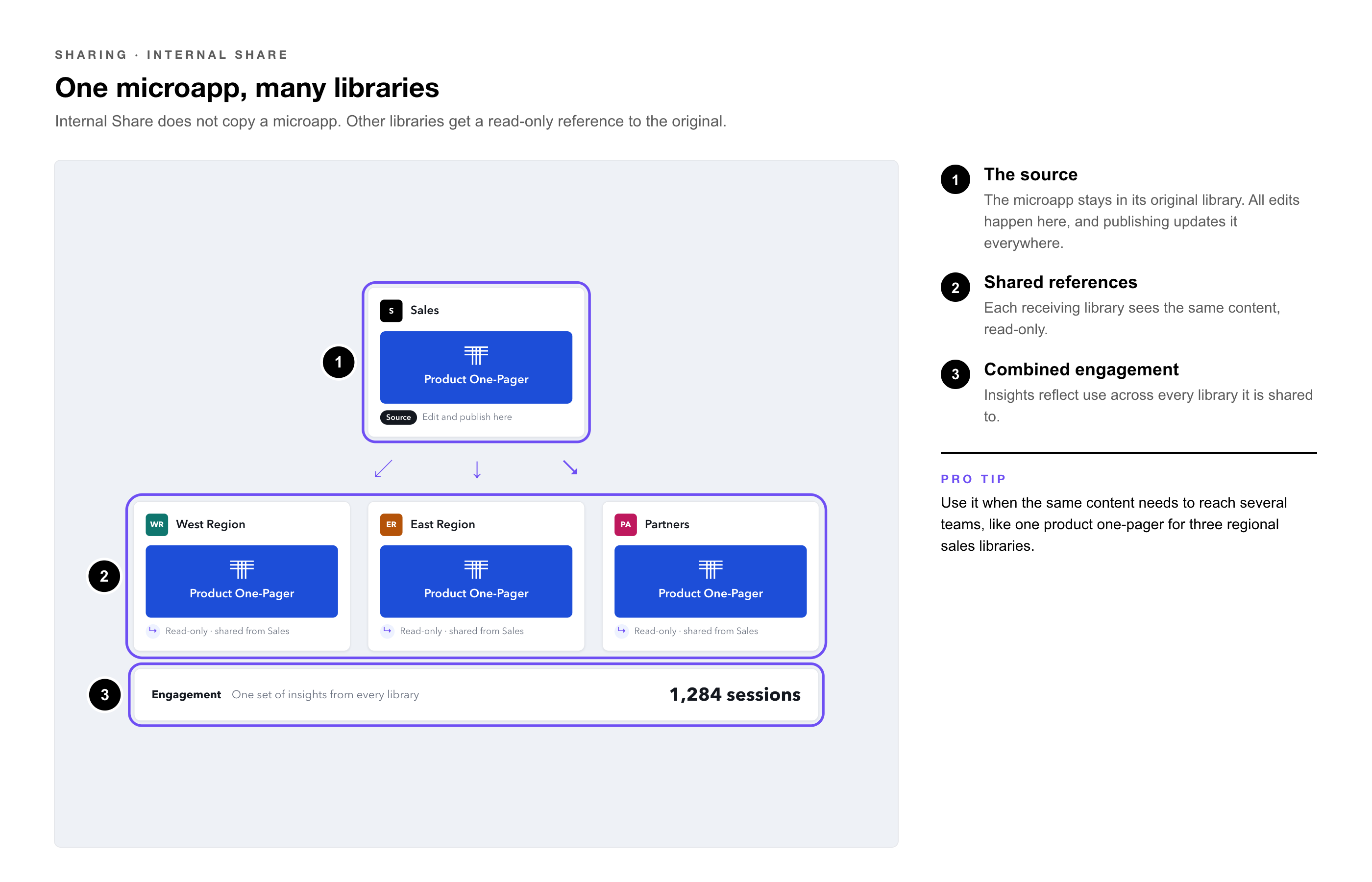
Internal Share gives users in other libraries access to a microapp without the ability to edit it. The microapp stays in its original library as the single source of truth, and every library it is shared to sees the same content — so an update at the source reaches everyone at once, with no duplicate copies to maintain.
How Internal Share Works
Sharing a microapp internally does not copy it. The receiving library gets a read-only reference back to the original, which means:
• The microapp cannot be edited in any library it is shared to — all edits happen at the source.
• Publishing an update at the source updates the microapp everywhere it appears.
• Engagement data is combined: insights for a shared microapp reflect all use across every library.
|
Pro Tip: This is the right tool whenever the same content needs to reach several teams — a product one-pager used by three regional sales libraries, say. One microapp to update instead of three copies drifting apart. |
|
Heads Up: In Builder 1.0, sharing from the Library, Builder, and Viewer could open different interfaces with different options. These were unified in Builder 2.0, so every share entry point now opens the same form with the full set of options. It no longer matters where you start the sharing process. |
Internal Share from the Library
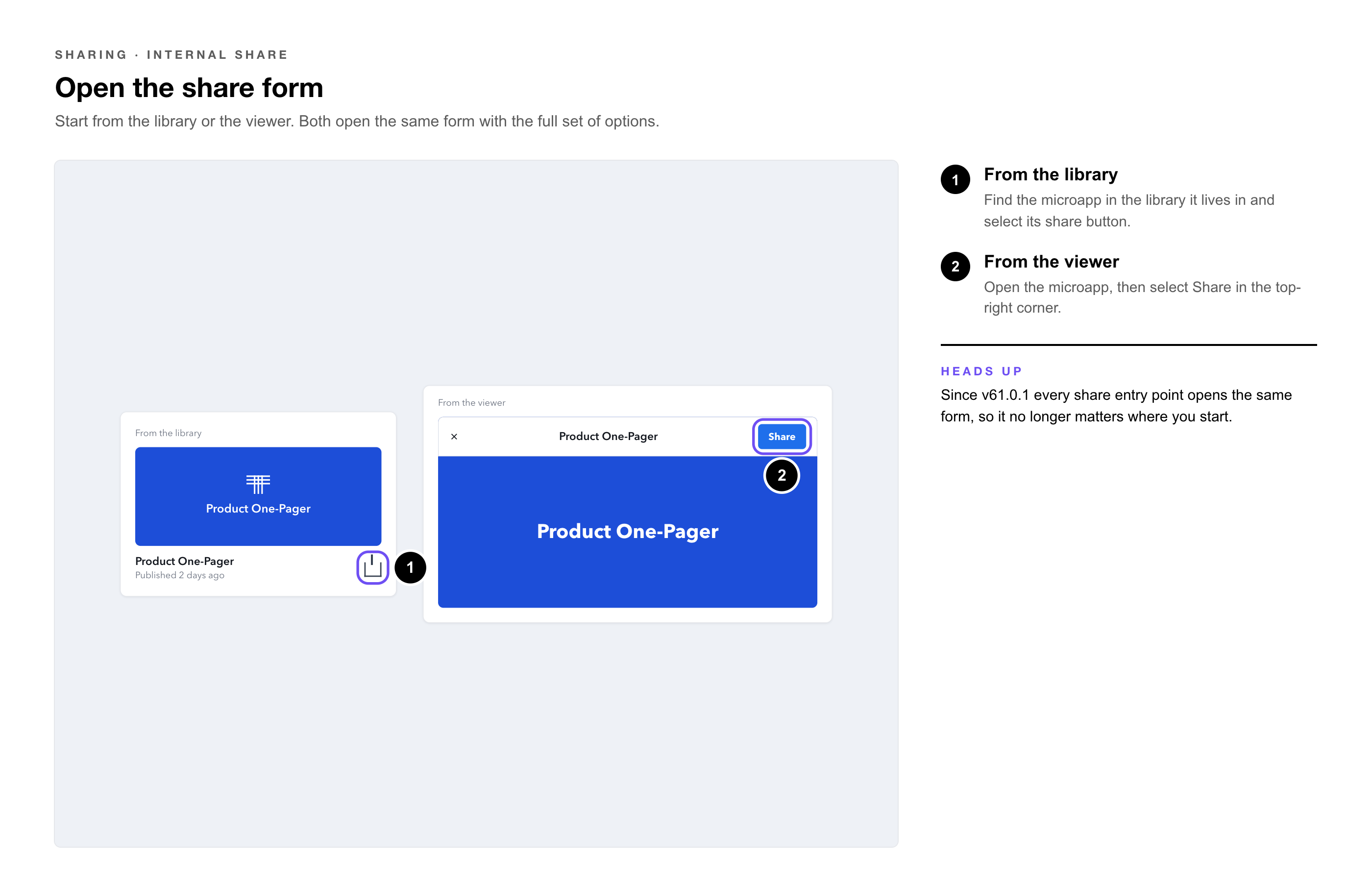
You can start from either the library or the microapp viewer. Both open the same share form, so the steps are identical once it is open.
Opening the share form
|
Starting point |
How to open it |
|
From the library |
Find the microapp in the library it lives in and click the share button. |
|
From the viewer |
Click the microapp cover to open the viewer, then click Share in the top-right corner. |
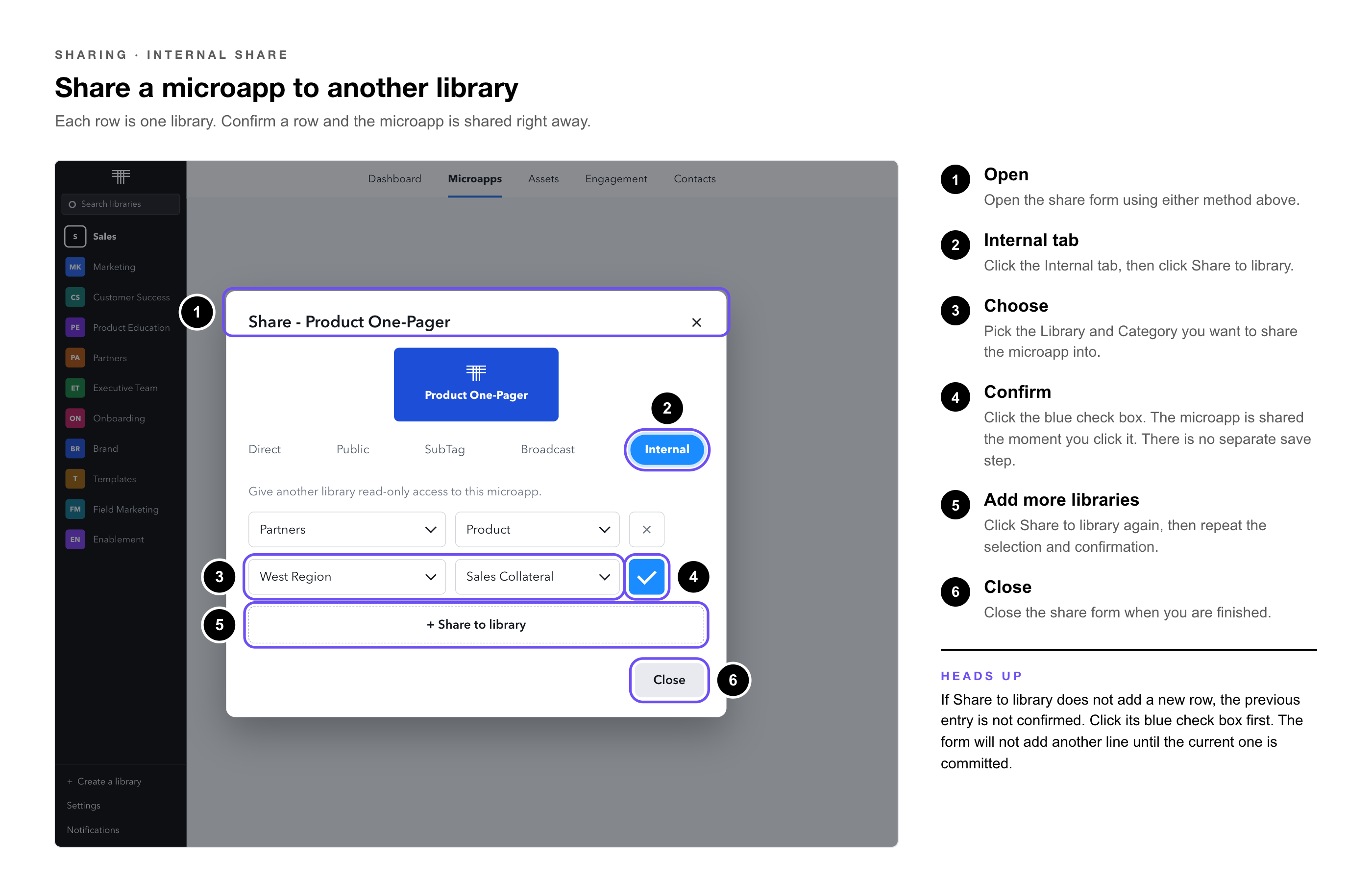
1. Open — the share form using either method above.
2. Click — the Internal tab, then click Share to library.
3. Choose — the Library and Category you want to share the microapp into.
4. Confirm — your selection by clicking the blue check box. The microapp is shared the moment you click it — there is no separate save step.
5. Add more libraries — by clicking Share to library again, then repeating the selection and confirmation.
6. Close — the share form when you are finished.
|
Heads Up: If clicking Share to library does not produce a new row, the previous entry has not been confirmed. Click the blue check box next to it first — the form will not add another line until the current one is committed. |
Internal Share from the Microapp Viewer
- Click on the cover of the microapp to enter the microapp viewer.
- Click the Share button in the top right corner of the viewer.
- Click the Internal tab on the resulting share window, then clickShare Library.
- Choose the Library and Category you would like to share your microapp with. Ensure your selection is confirmed by clicking the blue check box.
- To share with multiple libraries, click the Share to Library button again. If you are not seeing a new line appear, ensure you have clicked the blue check box next to your prior entry.
- Microapps are shared as soon as the blue check box is clicked. Once you are done adding libraries, you can close the share window.
Identifying a Shared Microapp
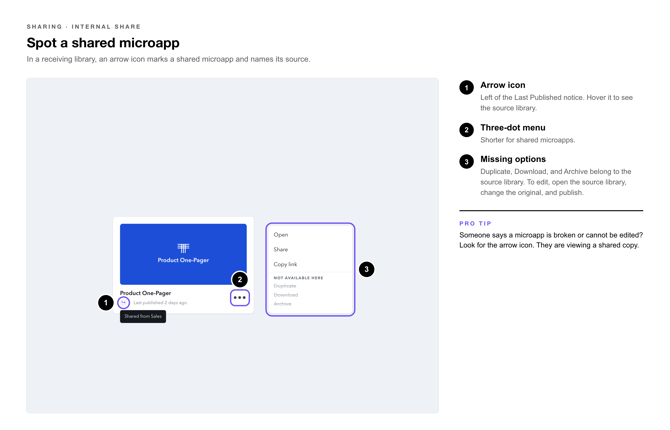
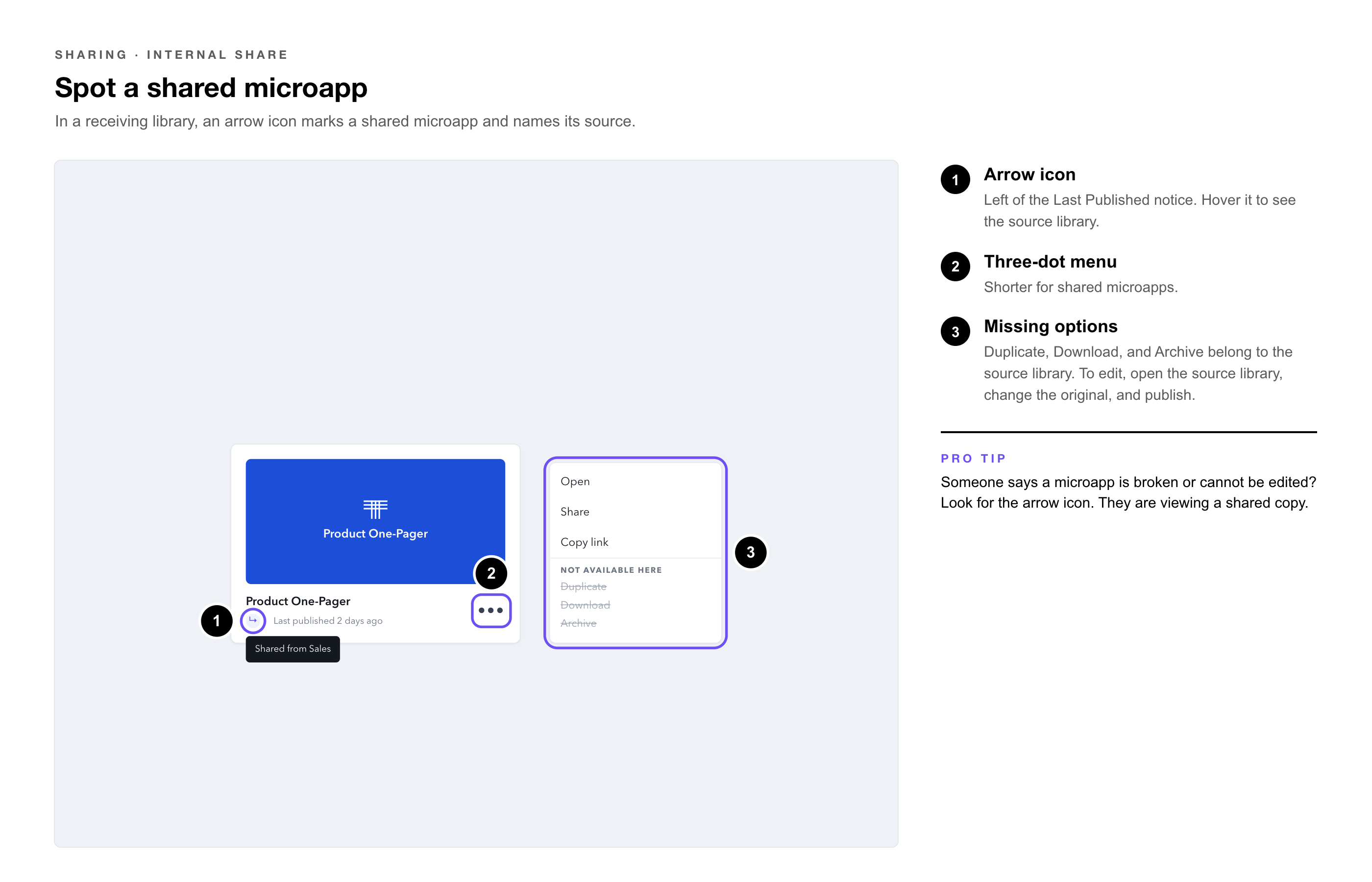
In a library that received a microapp through Internal Share, an arrow icon appears to the left of the Last Published notice beneath the microapp cover. Hover over the icon to see which library the original lives in.
The three-dot menu is also reduced for shared microapps. These options do not appear:
• Duplicate — the microapp belongs to its source library and cannot be copied from here.
• Download — unavailable on a shared reference.
• Archive — archiving is handled in the source library.
|
Pro Tip: The missing three-dot options are usually the first clue when someone reports that a microapp is “broken” or that they cannot edit it. Check for the arrow icon — it means they are looking at a shared copy and need to work in the source library instead. |
 Editing a Shared Microapp
A shared microapp cannot be edited in the library it was shared to. To change it, open the source library — the one named in the arrow icon tooltip — and edit the original there. Your changes reach every library the microapp is shared with when you publish.
|
Heads Up: This is the trade-off that makes Internal Share useful. If a receiving team needs its own version they can change independently, Internal Share is the wrong tool — they need their own microapp, which means accepting that the two will diverge. |
Removing a Shared Microapp from a Library
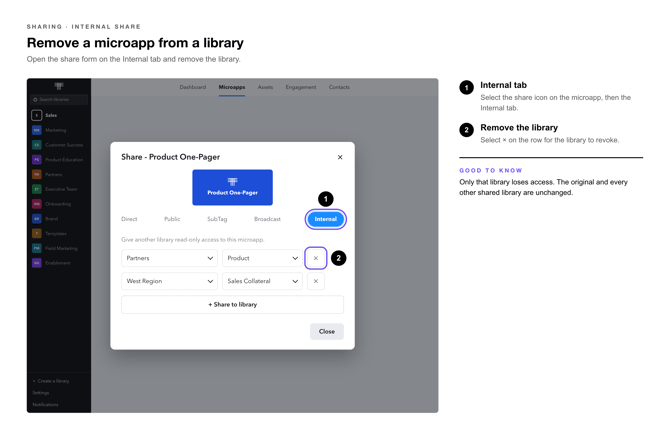
1. Find — the internally shared microapp.
2. Click — the share icon.
3. Select — the Internal tab.
4. Remove — the library you want to revoke access from.
Removing a share affects only the receiving library. The original microapp and every other library it is shared to are unchanged.
Internal Share vs. Similar Features
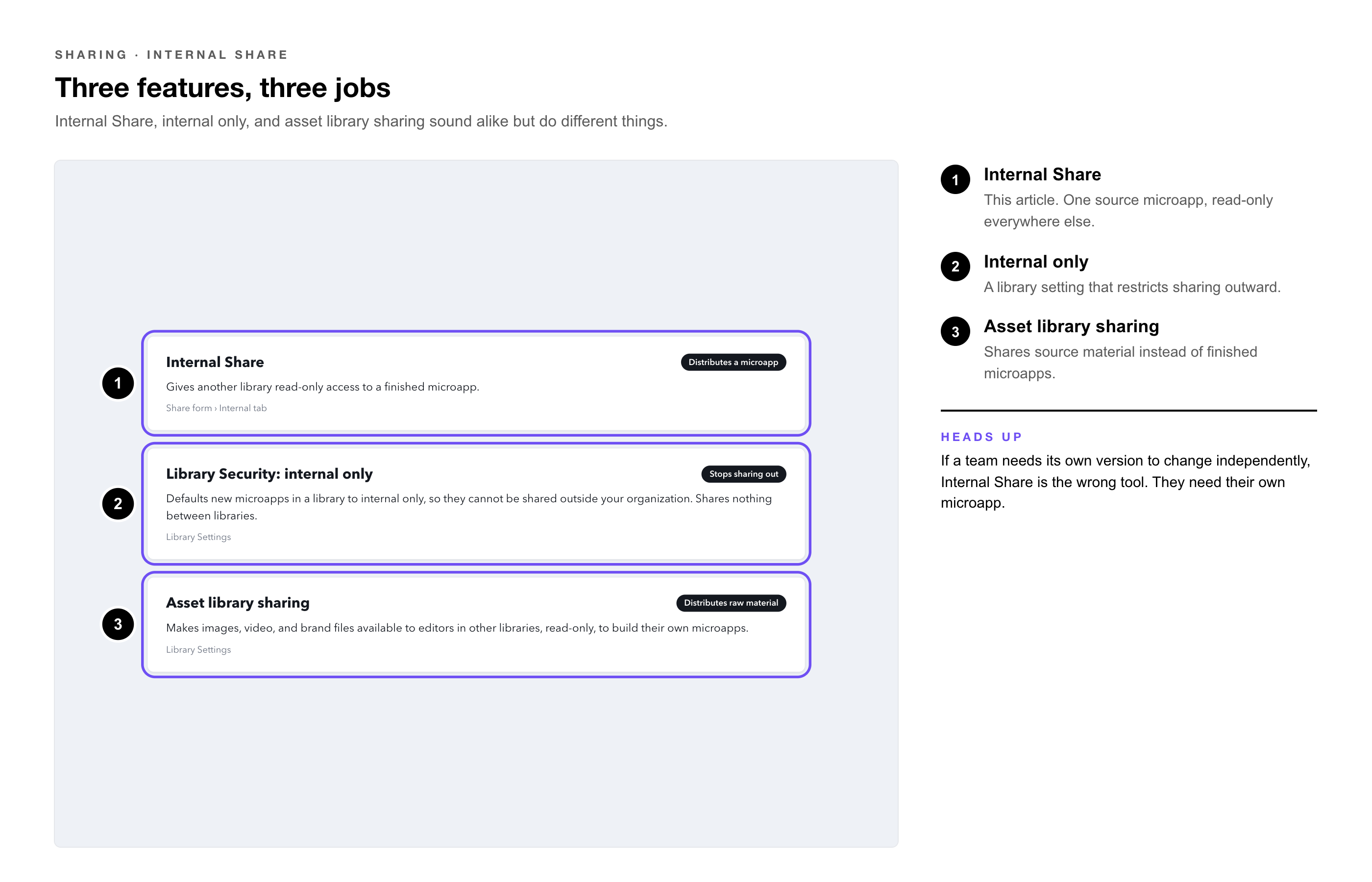
Three different Tiled features involve the word “internal” or share content across libraries. They do different things.
|
Feature |
What it does |
|
Internal Share (this article) |
Gives another library read-only access to a specific microapp. Configured from the Internal tab of the share form. |
|
Library Security — internal only |
A library setting that defaults new microapps in that library to internal only, disabling external sharing for them. It restricts sharing outward; it does not share anything between libraries. Configured in Library Settings. |
|
Asset library sharing |
Makes a collection of assets — images, video, brand files — available to editors in other libraries, read-only, so they can build their own microapps with approved content. Shares source material rather than finished microapps. Configured in Library Settings. |
|
Pro Tip: A quick way to keep them straight: Internal Share distributes a finished microapp, asset library sharing distributes the raw material, and internal only stops a microapp leaving your organization at all. |
Common Questions
|
Question |
Answer |
|
Why can’t I edit this microapp? |
Look for an arrow icon to the left of the Last Published notice under the cover. If it is there, the microapp was shared into this library from another one and is read-only. Hover the icon to see the source library, and make your edits there. |
|
Do my edits reach the other libraries automatically? |
Yes. Every library sees the same microapp, so publishing an update at the source updates it everywhere it is shared. |
|
Clicking Share to library doesn’t add a new row. What’s wrong? |
The previous entry has not been confirmed. Click the blue check box next to it, then Share to library will add another line. |
|
Is there a save button on the share form? |
No. The microapp is shared as soon as you click the blue check box. Once you have added the libraries you want, simply close the form. |
|
Whose analytics does a shared microapp show? |
Insights for a shared microapp reflect all use across every library it appears in, combined — not just activity in the source library. |
|
Why are Duplicate, Download, and Archive missing? |
Those actions belong to the source library. A shared microapp is a read-only reference, so the three-dot menu is reduced in any library that received it. |
|
What happens if I remove a shared library? |
Only that library loses access. The original microapp and any other libraries it is shared to are unaffected. |
|
The receiving team wants their own version they can change. Can they? |
Not through Internal Share — it is read-only by design. They would need their own microapp, which means maintaining it separately and accepting that the two versions will diverge over time. |
Related Articles
-
How to Use the Unified Share Form in Tiled — The share form all entry points now open, and the options available in it.
-
How to Share an Asset Library Between Microapp Libraries — Sharing assets rather than finished microapps across libraries.
-
Library Settings: General — Library-level settings including the internal only security default.
-
Direct Share Links — Sharing a microapp externally with a known recipient.
-
Engagement: Microapp Analytics — Reading the combined engagement data for a shared microapp.
-
Managing Microapp Categories — Categories you can share a Microapp into.
- Share from the Microapp Viewer — The simplest way to keep a growing Microapp Library organized.
- Viewing Shared Microapps — View an internal shared Microapp
- Removing Internally Shared Microapps from a Library — Remove an internal shared microapp