![logo-horizontal_w.png]](https://support.tiled.co/hs-fs/hubfs/logo-horizontal_w.png?height=30&name=logo-horizontal_w.png)
We’re excited to release the Tiled plugin for Sketch to make building microapps easier than ever. With the plugin, you'll be able to sync screens, create adaptive artboards, and link hotspots. And team feedback submitted through the Tiled App will be visible in Sketch as well. Now you can sync with Tiled to quickly distribute your microapps, gain powerful insights, and make the iteration process seamless.
Download the Tiled plugin for Sketch
What the Plugin Does
|
Feature |
What It Does |
|
Sync artboards |
Artboards at your adaptive format size become microapp pages. Other sizes become assets. |
|
Create microapps |
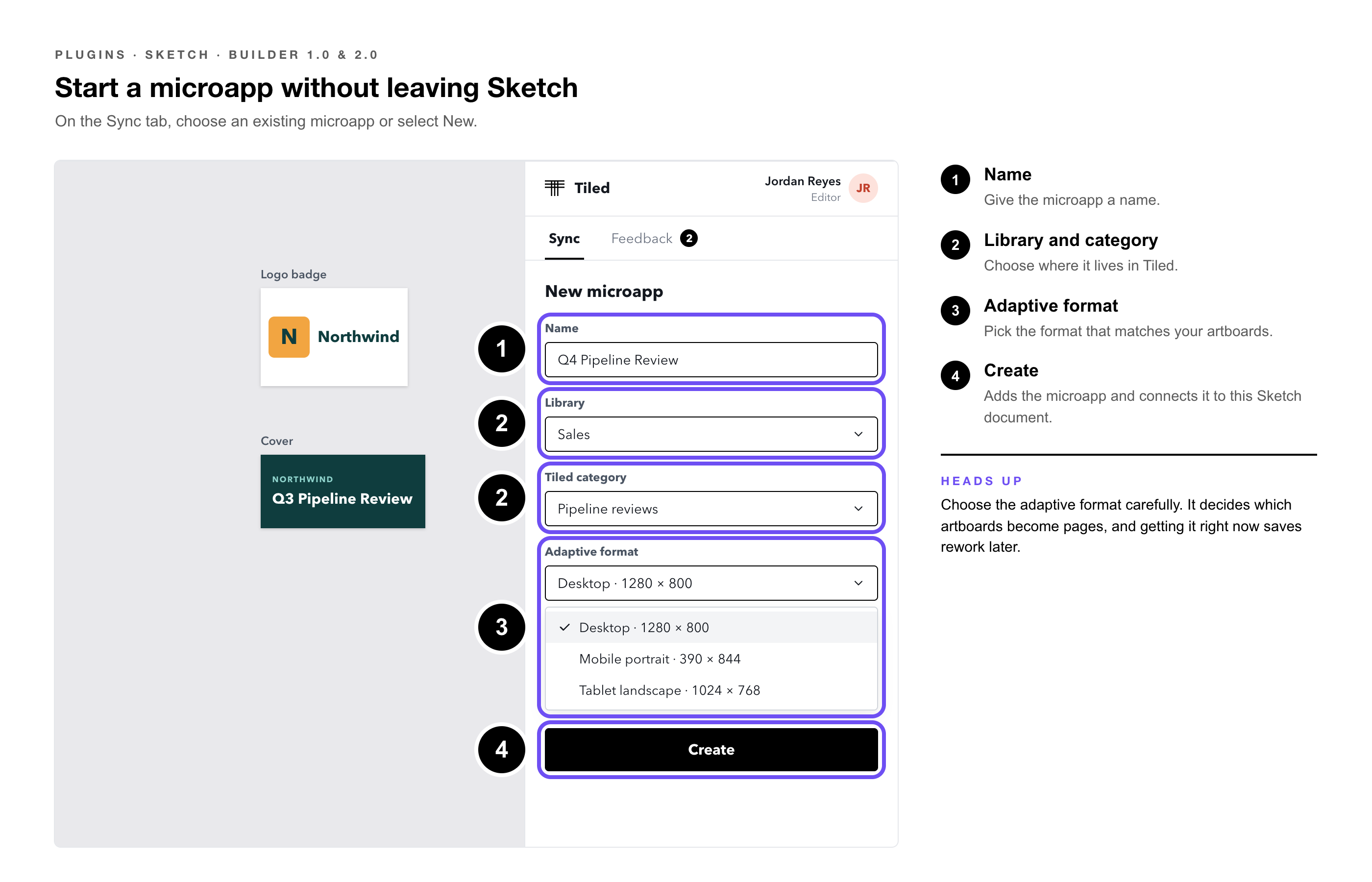
Start a new microapp and choose its library, adaptive format, and category without leaving Sketch. |
|
Link pages |
Links between artboards become hotspots in Tiled. |
|
Smart Syncing |
Recognizes cover-size artboards and pre-selects or remembers each artboard’s adaptive format. |
|
Feedback |
Shows feedback your team leaves in Tiled, next to the screen it’s about. |
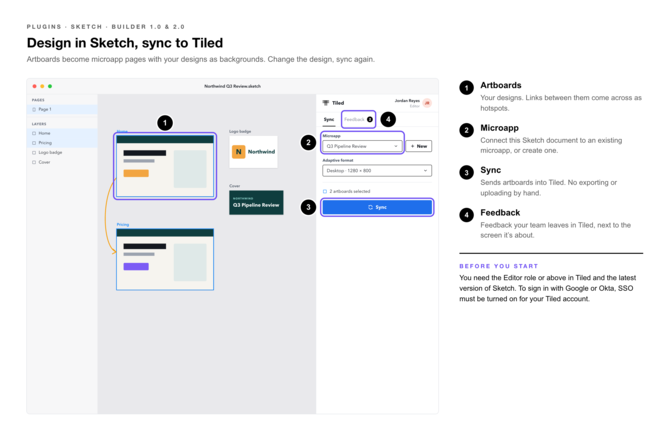 Before You Start
• Role — you need the Editor role or above in Tiled to use the plugin.
• Sketch — use the latest version of Sketch. Outdated software is a common cause of sync problems.
• SSO — if you sign in with Google or Okta, SSO must be turned on for your Tiled account first.
Using the plugin
Step 1: Install the Plugin
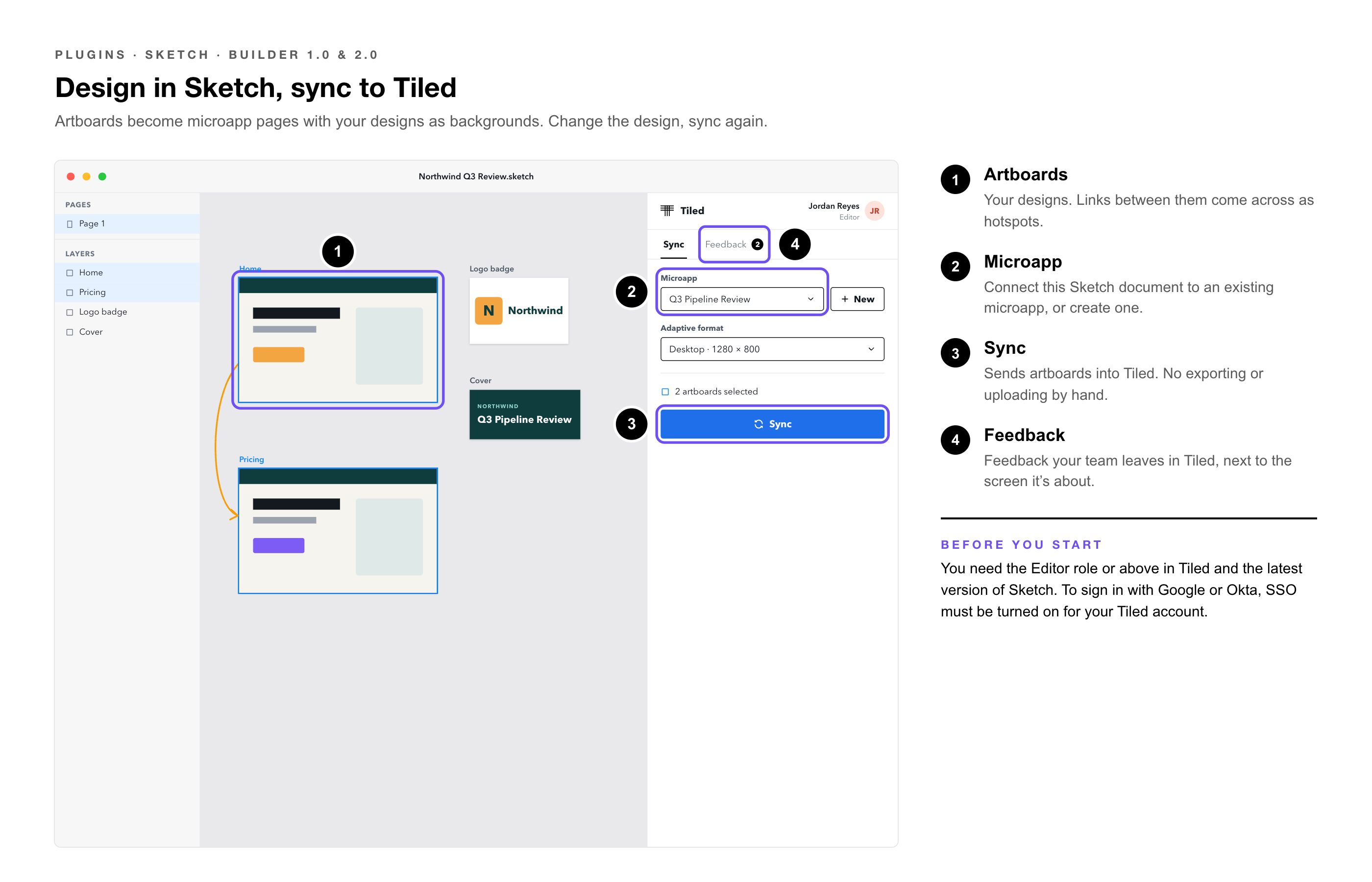
1. Download the plugin — from the Tiled for Sketch page on tiled.co.
2. Unzip the download — and double-click Tiled.sketchplugin. Sketch installs it.
 Download: Tiled for Sketch plugin
Step 2: Sign In and Connect a Microapp
1. Open the plugin — from Sketch’s Plugins menu by selecting Tiled.
2. Sign in — with the email and password you use for Tiled on the web, or select Google or Okta to sign in with SSO. For SSO, enter your company domain and finish signing in in your browser within five minutes.
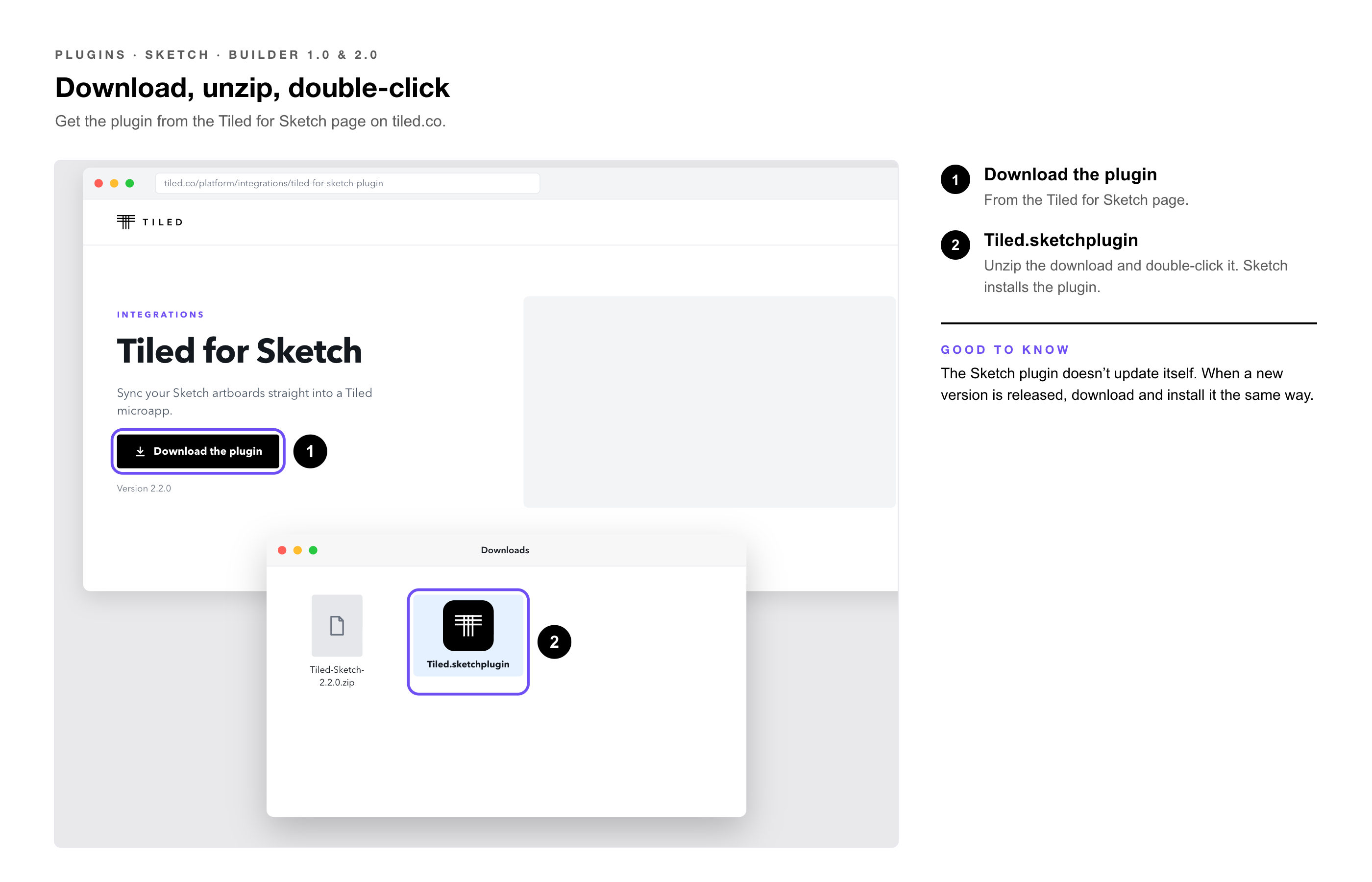
3. Choose a microapp on the Sync tab. — Connect your Sketch document to an existing microapp, or create a new one.
4. If you create a new microapp, — name it, choose its library and Tiled category, and pick the adaptive format that matches your artboards.
|
Heads Up: Choose the adaptive format carefully. It decides which artboards become pages, and getting it right now saves rework later. |
Step 3: Design in Sketch
|
Your Artboard |
What It Becomes in Tiled |
|
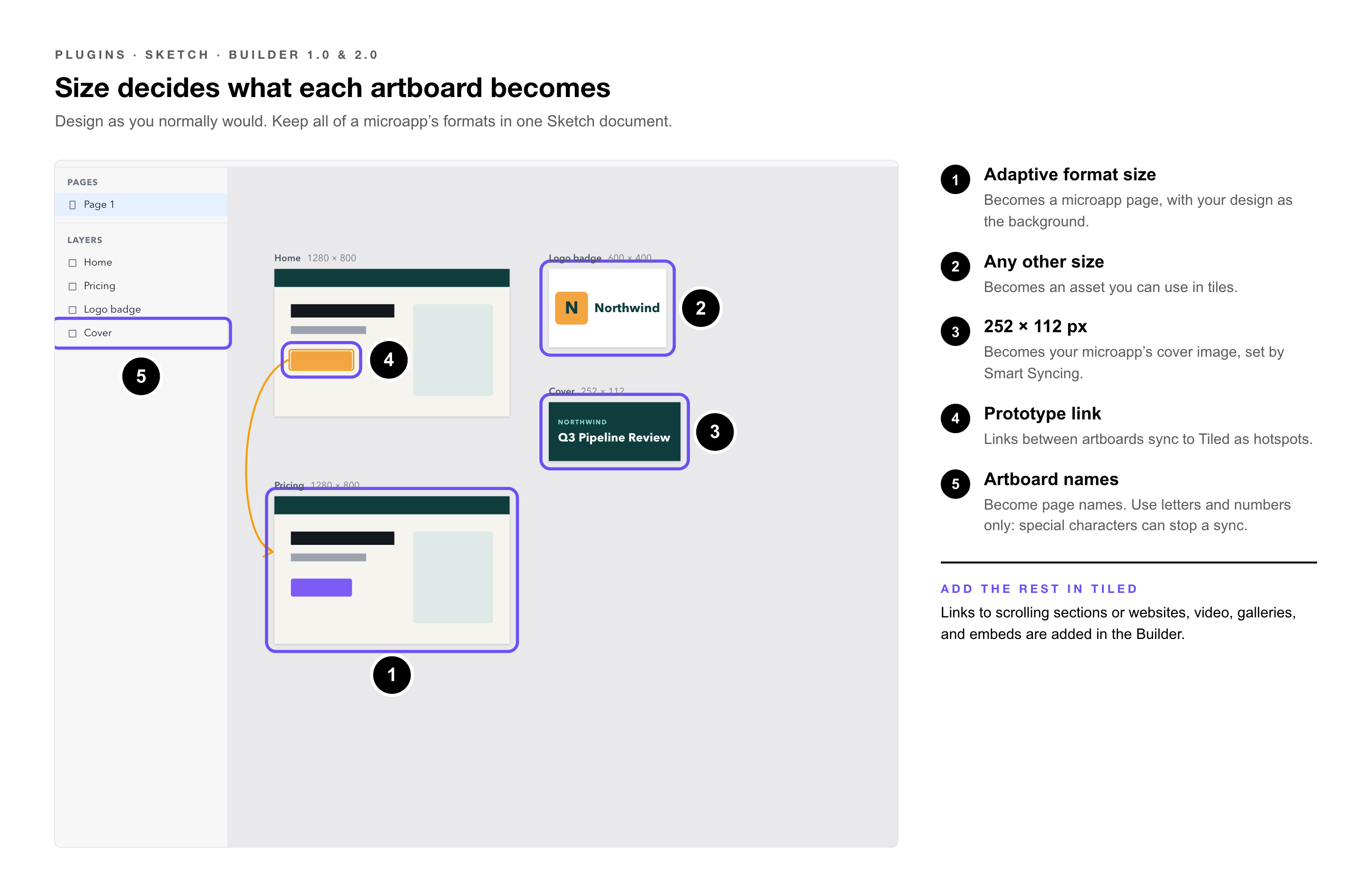
Exactly your adaptive format size |
A microapp page, with your design as the background. |
|
Any other size |
An asset you can use in tiles. |
|
252 × 112 px |
Your microapp’s cover image, set automatically by Smart Syncing. |
• Link pages with hotspots — links between artboards sync to Tiled as hotspots.
• Add the rest in Tiled — links to scrolling sections or external websites, video, galleries, and embeds are added in the Builder.
• Name artboards clearly — use letters and numbers only. Artboard names become page names, and special characters can stop a sync.
• One microapp per file — keep all of a microapp’s formats in one Sketch document.
Step 4: Sync to Tiled
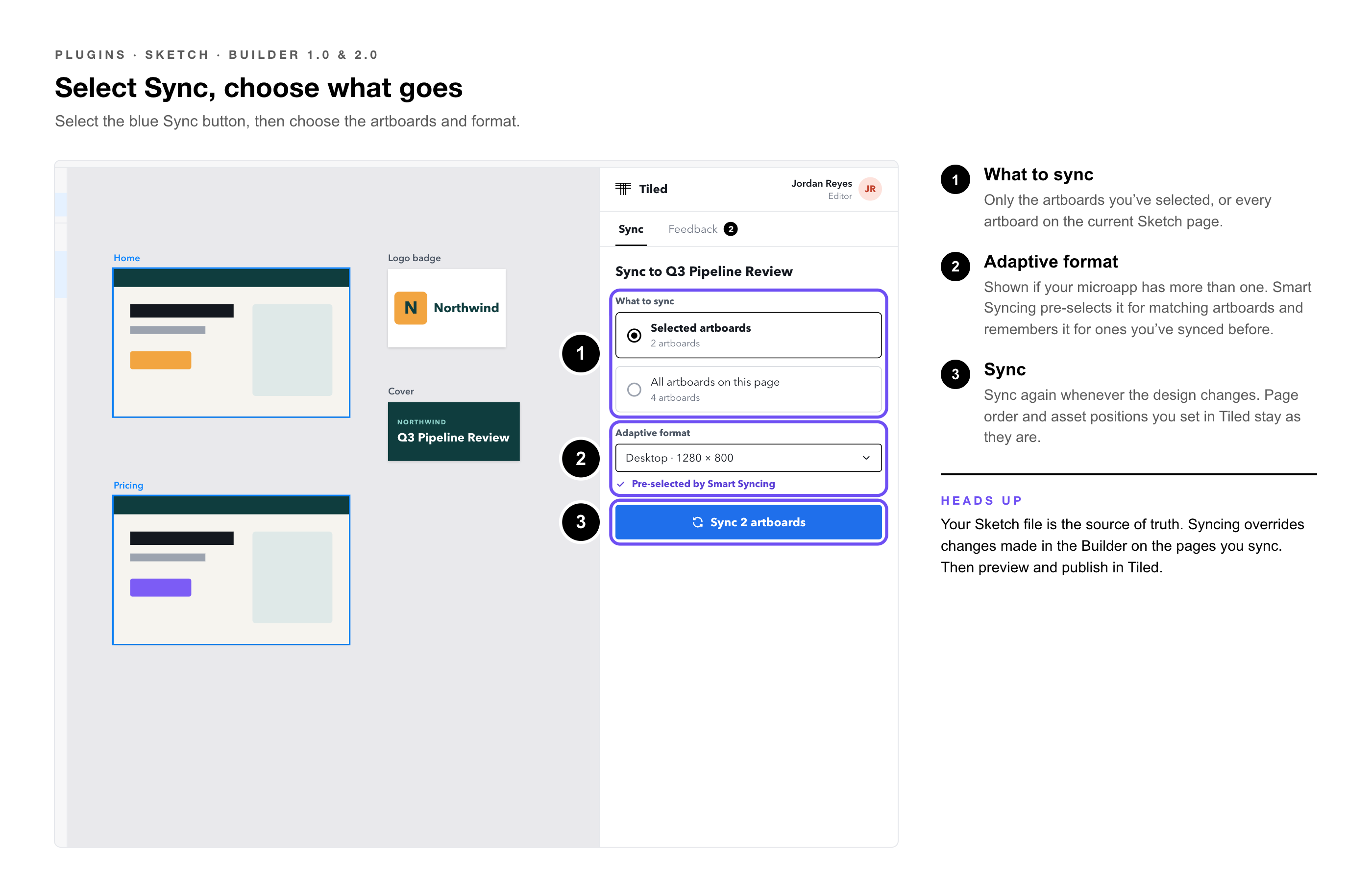
1. Select the blue Sync button — in the plugin.
2. Choose what to sync: — only the artboards you’ve selected, or every artboard on the current Sketch page.
3. Choose the adaptive format — if your microapp has more than one. Smart Syncing pre-selects it for matching artboards and remembers it for artboards you’ve synced before.
Sync again whenever you change the design, for one page or the whole microapp. Re-syncing updates your designs but keeps the page order and asset positions you set in Tiled.
|
Heads Up: Your Sketch file is the source of truth. Syncing overrides changes made in the Builder on the pages you sync, so make design changes in Sketch. |
Step 5: Finish and Publish in Tiled
1. Open the microapp in the Builder — and add video, galleries, embeds, and any other interactions.
2. Preview — to check every hotspot and link.
3. Publish — and share it with your team or your audience.
Reviewing Feedback in Sketch
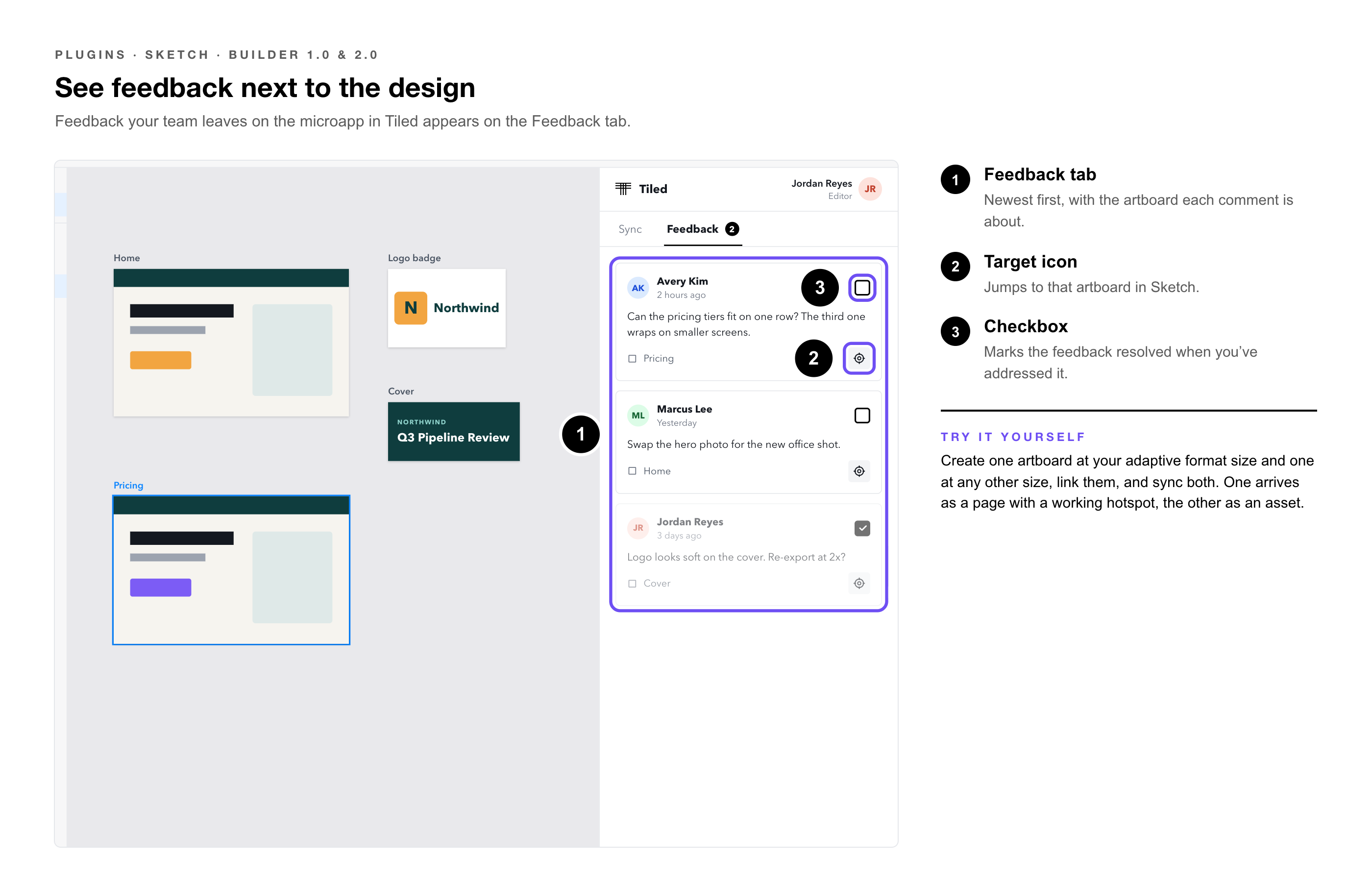
Feedback your team leaves on the microapp in Tiled appears on the plugin’s Feedback tab.
• Find the screen — select the target icon to jump to the artboard the feedback is about.
• Mark it resolved — check the box when you’ve addressed it.
Download the Tiled plugin for Sketch
|
Try It Yourself: Create two artboards, one at your adaptive format size and one at any other size, link them with a hotspot, and sync both. In Tiled, one arrives as a page with a working hotspot and the other as an asset. |
Common Questions
|
Question |
Answer |
|
Why did my artboard come in as an asset? |
Its size doesn’t exactly match your adaptive format. Resize it and sync again. |
|
Will syncing undo my changes in Tiled? |
Page order and asset positions stay as they are. Design changes made in the Builder on synced pages are replaced by the Sketch design. |
|
Can I sync desktop and mobile artboards together? |
No. Sync one adaptive format at a time. |
|
Why didn’t my external link come across? |
Only links between artboards sync, as hotspots. Add external links and links to scrolling sections in the Builder. |
|
Does the plugin work with Builder 2.0? |
Yes. It works the same way for Builder 1.0 and Builder 2.0 microapps. |
|
The plugin stopped working after an update. |
Make sure both Sketch and the plugin are on their latest versions. See Troubleshooting the Tiled Plugin. |
Related Articles
• Syncing With Plugins: Overview — Pages, assets, Smart Syncing, and cover images.
• Logging Into the Tiled Plugins — Signing in, including with SSO.
• Troubleshooting the Tiled Plugin — Fixing sync problems step by step.
• Tiled Plugin for Figma — The Figma version of the plugin.
• Tiled Plugin for Adobe XD — The Adobe XD version of the plugin.
• Getting Started for Designers — From first idea to a published microapp.